

Demystifying Venture Capital
An In-Depth Look at VC Mechanics and Impact in India

Venture capital (VC) is a pivotal component of the financial landscape, particularly in the burgeoning Indian startup ecosystem. This in-depth article, based on a transcript involving knowledgeable speakers, delves into the intricacies of venture capital, its operational dynamics, and its significant role in shaping businesses from infancy to maturity.

Understanding Venture Capital
Venture capital represents institutional capital, distinctly separate from individual investments. This organized team-driven funding ranges significantly in size:
Small funds may encompass around 100 crores.
Larger funds can soar to staggering amounts, such as 25,000 to 50,000 crores in India and even $100 billion, as seen in the Vision Fund by SoftBank.
VC serves as a crucial lifeline for startups, providing the necessary capital to transition from conceptual stages to operational businesses. The funding spans various stages, starting with seed capital (typically in the range of 2 to 3 crores for individual companies) and progressing through series A, C, and beyond, until a company achieves profitability.
The Role of Venture Capital in Business Growth
Venture capital is instrumental in taking a company from its nascent stage to a point of profitability. Once a company is profitable and established, the focus often shifts to private equity or growth capital.
Key Players in the Indian Venture Capital Landscape
India's VC scene is vibrant, with numerous well-established firms. Prominent names include:
Peak XV Partners (Former Sequoia India)
These firms have been pivotal in fostering a conducive environment for startups in India.
Roles in a Venture Capital Firm
Typical roles in a venture capital firm include:
General Partners: Responsible for all fund investment decisions and normally invest their capital in the fund.
Venture Partners: Source investment opportunities and are paid based on deals they close
Principals: Mid-level, investment-focused position. With experience in investment banking or other experience relative to the fund’s investment strategy
Associates: Junior staff with some experience in investment banking or management consulting
Entrepreneur-in-Residence: Industry experts who are hired as advisors or consultants to the venture capital firm temporarily, often to assist with due diligence or pitching new startup ideas.
Fee Structure and Lifecycle of Venture Capital Funds
Typically, VC firms operate on a 10-year lifecycle with an option for a 2-3 year extension. The fee structure usually involves:
An annual management fee of 2% of the funds raised.
A 'carry', or carried interest, constituting 20% of the fund's gains.
This is only applicable upon the successful exit from an investment, which can occur through :
public offerings,
strategic sales (e.g., acquisition by larger companies like Google),
or buyouts by later-stage funds.
The Complexities of Venture Capital Returns
Determining the returns from venture capital investments is intricate. Unlike deal-by-deal returns in exclusive funds, most VC returns are subjected to a collective assessment, where the entire capital invested, plus the fees consumed over the fund's lifecycle, must be recouped before any profit-sharing occurs.
The Investment and Return Mechanism
The distribution of profits follows a European or American waterfall model, where fund managers receive carry only after returning the total capital invested, along with the fees consumed. The incentives are aligned to encourage hard work as it may take several years before the fund managers can realize any profits from their investments.
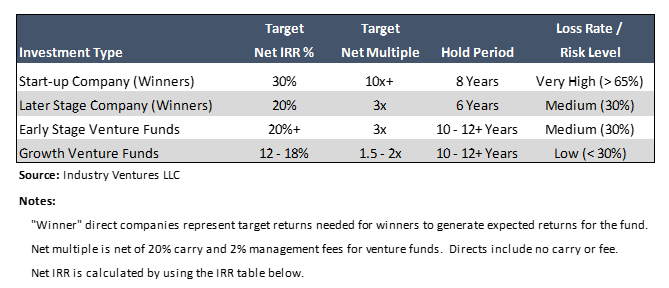
For instance, if a VC invests 100 bucks, only about 80 is typically invested directly into businesses, with the remaining 20 covering various expenses. The fund must not only return the entire 100 but also meet a threshold internal rate of return (IRR), which often ranges from 8 to 10%. Only after surpassing this threshold can the fund begin to distribute profits and carried interest.
A detailed insight of what is a quite plausible expectation from various assets can be found in this image from the blog post of Industry Ventures LLC :
The Long Road to Returns
The journey to realizing returns in VC is long and arduous. Even successful funds may take a decade to see substantial returns. The stringent criteria for profit distribution ensure that the interests of fund managers are closely aligned with the performance of their investments, thereby fostering a highly motivated approach to business growth and success.
Conclusion
Venture capital in India, while complex and challenging, is a vital cog in the wheel of entrepreneurial success. It not only provides the necessary financial backing for startups but also ensures a rigorous, performance-driven approach to business development. As the Indian startup landscape continues to evolve, the role of venture capital will undoubtedly become increasingly significant, shaping the future of innovation and entrepreneurship in the region.